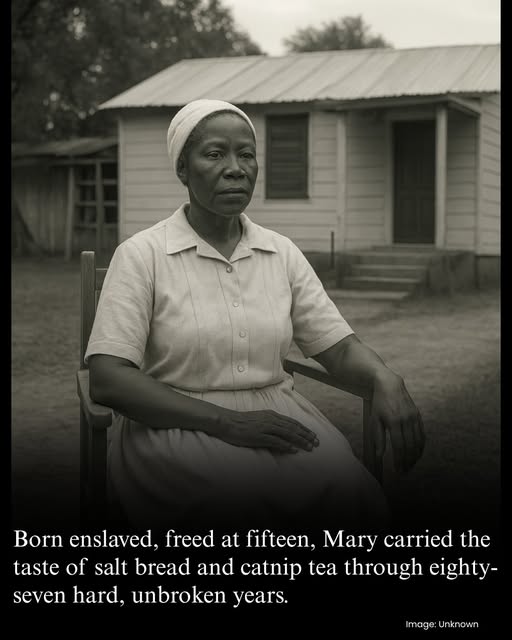
By 1938, Mary Thompson was an old woman—eighty-seven years behind her, white hair, lined hands, and a slow, careful walk. She lived in a small house at **1104 East Avenue in Austin, Texas**, far from the Alabama fields where her life had begun in bondage. When she spoke about the past, her words carried both the weight of sorrow and the matter-of-fact steadiness of someone who had survived it all.
Mary had been born enslaved in **Denton, Miringo County, Alabama**, on a plantation owned by a man named **Green Askew**, a white Georgian. Her mother, **Viney**, had taken her enslaver’s last name—Askew—and her father, **Wesley**, had taken the name of his. That was how it was, she would explain: families broken and renamed according to the men who claimed them.
“I come here from Alabama,” she’d begin, voice gentle but firm. “My mama was Viney, and she was owned by Marse Green Askew. My daddy, Wesley Jones, he carried his marster’s name too.”
Mary was fifteen when freedom finally came, but the years before that were shaped entirely by the rhythms of plantation life.
Her mother worked in the big house as a cook. Mary remembered the kitchen as hot and noisy, with a stove so large it seemed to swallow the room. Viney could feed a crowd—biscuits, stews, vegetables—and she knew how to make **salt-rising bread** that stayed in Mary’s memory long after other details had faded. While Viney worked in the main house, Mary and the other enslaved people lived in cabins grouped not far from their enslaver’s home. The cabins were close enough for the owner’s eye to be everywhere, but just far enough away for the enslaved families to hold on to a small sense of their own world.
Not all children on the place had both parents in those cabins. Mary had seen, even as a girl, that some children were the sons and daughters of enslaved women and the white man who owned them. It was something people rarely named out loud, but everybody knew. It was just one more way the power of the master reached into every corner of their lives.
Days on the plantation started before the sun and stretched until it sank again. Mary worked in the fields with the others, bent over rows of crops in the Alabama heat. In the evenings, when they finally walked back to the cabins, the women still had to prepare the food. The same hands that had hoed and picked all day stirred pots and cut vegetables by lamplight. By the time supper was ready and eaten, there was little energy left for anything else.
“We didn’t do much visiting or playing at night,” Mary would say. “Folks was too wore out. Mostly, you just ate what you had and lay down.”
But not every day was like that. The calendar held a few bright spots, and Mary remembered them with a soft, faraway smile.
Christmas was one of those days. On that morning, their enslaver would sometimes hand out treats to the people he owned—things he would never give them on a regular day. There might be eggnog, sweets, and a bit more food than usual. For a few hours, the atmosphere shifted. People would sing, voices rising together in songs Mary could no longer quite recall in her old age, only the feeling of them—of warmth, of brief relief, of something like joy squeezed into the smallest possible space.
Another special time came around the Fourth of July. On the plantation where Mary grew up, the main crops in Alabama were usually finished by early July. After the hard work of clearing and harvesting, their enslaver would sometimes declare several days of rest. It was not kindness so much as habit and tradition, but the enslaved people took what they could from it. During those days, they were given pits full of barbecued meat, pies, and cakes. For once, the food was abundant, and people could eat until they had their fill. It didn’t cancel out the long months of labor, but it created memories that stayed with Mary for the rest of her life—memories of full plates and laughter, rare luxuries in a life ruled by someone else’s demands.
Illness was a constant presence in that world. Alabama was thick with chills, fevers, and ague, and medical care depended on a mix of the enslaver’s decisions and the community’s own knowledge. If someone grew seriously ill, the owner might send for a doctor—more to protect his property than from concern for their comfort. But long before any doctor arrived, the enslaved people relied on herbal remedies passed down through generations.
Mary described how they made teas from plants gathered in the fields and woods. Catnip tea was used to bring down fevers, especially in children. They brewed blue and white sage to fight sickness and strengthen the body. For babies with stomach pains and colic, they used calamus root, a plant that looked a little like an onion and carried a strong, medicinal flavor. These remedies were part of a different kind of knowledge—Black knowledge, family knowledge, the kind that had kept people alive long before anyone called for a white doctor.
Through it all, Mary’s life followed the same pattern as those of millions of others born enslaved in the American South: work, exhaustion, small celebrations, homemade medicines, grief, and endurance. Yet buried within that pattern was something else—an unspoken insistence on survival.
When freedom finally came, Mary was a teenager, about fifteen years old. The moment did not erase the years behind her, nor did it magically create safety or wealth. But it did something immeasurably important: it meant that from then on, no one could legally buy or sell her. No one would own her children. No one would decide where she slept by writing her name in a ledger. That change, though it came late and incomplete, was a turning point that allowed her eventually to leave Alabama behind and build a life in Texas.
By the time she reached her late eighties in Austin, Mary had lived through chattel slavery, the Civil War, Emancipation, Reconstruction, segregation, and the early rumblings of a new century. She had moved from a cabin in Alabama to a house in a Texas city, from days ruled by a master’s schedule to days ruled by her own slow, steady pace. The memories of the plantation—her mother in front of the massive stove, the holiday food, the taste of catnip tea, the long walk from the fields—were never far from her mind.
She told her story not with drama, but with a quiet clarity. It was the voice of someone who had seen the worst of what people could do to one another and had still managed to keep moving, keep remembering, and keep living.