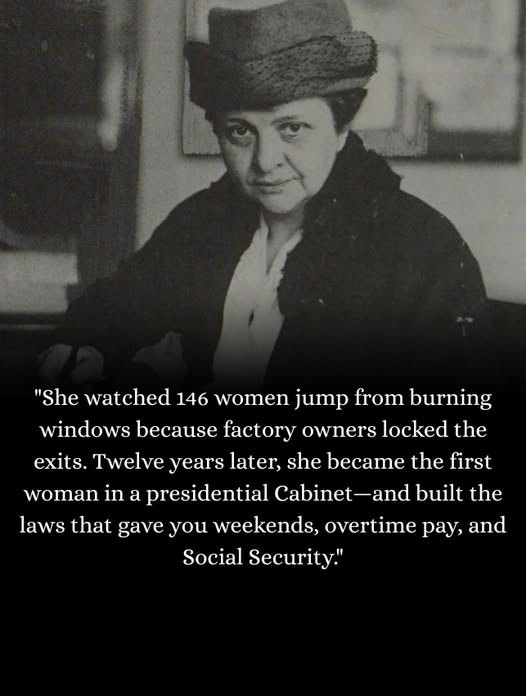
She watched 146 women jump from burning windows because factory owners locked the exits. Twelve years later, she became the first woman in a presidential Cabinet—and built the laws that gave you weekends, overtime pay, and Social Security.
Her name was Frances Perkins. And she turned the Triangle Shirtwaist fire into the foundation of American worker protection.
As a girl, Frances Perkins couldn’t understand why good people lived in poverty.
Her father said the poor were lazy or weak—that poverty was a character flaw, a moral failing, a natural result of insufficient effort.
Frances, even as a child, knew that couldn’t be true.
At Mount Holyoke College in the early 1900s, she studied physics—safe, respectable, appropriate for a young woman of good family. Then came a class trip that shattered her comfortable worldview forever.
Her professor took students to tour factories along the Connecticut River.
Frances saw exhausted girls younger than herself bent over dangerous machines in rooms with no windows, no ventilation, no exits. Twelve-hour shifts. Six-day weeks. Seven days if the factory needed it. Fingers lost to machinery. Lungs destroyed by cotton dust. Children as young as 10 working beside adults.
She realized that knowledge meant nothing if it didn’t help people live with dignity.
She abandoned the safe path—marriage to a suitable man, teaching piano to rich children, a comfortable life of domestic propriety. Instead, she earned a master’s degree at Columbia University in economics and sociology, writing her thesis on malnutrition in Hell’s Kitchen—one of New York’s poorest immigrant neighborhoods.
Her family was horrified. Nice girls from respectable families didn’t study poverty. They certainly didn’t live in settlement houses with immigrants, learning their languages, documenting their suffering.
Frances didn’t care what nice girls did.
By 1910, she was Executive Secretary of the New York Consumers League, investigating factories, documenting violations, pushing relentlessly for reform. Clean bakeries. Safe exits. Maximum working hours. Regulations that made factory owners furious.
She testified before legislative committees—a young woman in a severe tailored suit telling powerful men their factories were killing people, showing them photographs of injuries, reading testimony from workers too afraid to speak publicly.
The factory owners hated her. The newspapers mocked her. Politicians dismissed her.
She didn’t stop.
Then came March 25, 1911.
Frances was having tea with friends near Washington Square on a beautiful spring Saturday afternoon when she heard fire bells. She followed the smoke and the screaming to the Triangle Shirtwaist Factory—a ten-story building with flames pouring from the upper floors.
She stood on the street below and watched young women appear in ninth-floor windows.
The factory doors were locked. The owners locked them routinely to prevent “theft” and “unauthorized breaks”—to keep workers at their machines every possible minute, to squeeze every last cent of profit from their labor.
The fire escapes had collapsed. The single internal staircase was an inferno. The women had two choices: burn or jump.
They jumped.
Frances stood on the sidewalk and watched their bodies fall. One after another after another. The sound of impact—that terrible, final sound—repeated over and over.
146 workers died that day. Most were immigrant women and girls, some as young as 14. They’d been making shirtwaists—the fashionable blouses wealthy women wore to demonstrate their modernity and independence, their progressive values.
Frances watched them burn so rich women could look progressive.
She made herself a promise that day, standing in the street with their bodies around her: Their deaths will not be in vain.
Within weeks, Frances was appointed to the Factory Investigating Commission examining the fire. She didn’t just write a report documenting what went wrong. She rewrote New York’s labor laws from the ground up.
Unlocked fire exits—multiple exits, accessible, clearly marked.
Maximum occupancy limits.
Sprinkler systems mandatory.
Regular surprise safety inspections.
54-hour maximum workweek.
One mandatory day off per week.
Restrictions on child labor.
The factory owners fought every single provision. They called it “government overreach” and “job-killing regulation.” They said it would destroy American business. They said workers were trying to get something for nothing. They said the Triangle fire was a tragic accident, not a systemic problem.
Frances responded with photographs of the Triangle dead. With testimony from survivors whose friends had burned beside them. With cold economic data showing that safe workplaces were actually more productive, not less—that dead and injured workers cost more than safety measures.
New York passed the laws. Other states watched and followed. Within a decade, American workplaces had been transformed—not completely, not perfectly, but irreversibly.
And Frances Perkins became the most hated woman in industrial America.
Business groups called her a communist. Newspapers mocked her as an “old maid” meddling inappropriately in men’s affairs. (She’d actually married late in life to Paul Wilson, an economist who suffered from severe mental illness—a fact she kept fiercely private to protect him from forced institutionalization.)
She absorbed the hatred, the mockery, the threats, and kept working.
In 1933, Franklin D. Roosevelt—newly elected president facing the catastrophic Great Depression—asked Frances to join his Cabinet as Secretary of Labor.
She was 53 years old. No woman had ever served in a presidential Cabinet. Ever. The idea was considered radical, possibly unconstitutional, definitely improper. Many people believed women lacked the temperament for high office.
Frances said she’d do it—but only on her terms.
She handed Roosevelt a list of demands:
A 40-hour workweek
A minimum wage
Complete abolition of child labor
Unemployment insurance
Old-age pensions (what would become Social Security)
Roosevelt looked at the list and said, “You know this is impossible.”
“Then find someone else,” Frances replied calmly.
Roosevelt appointed her anyway.
For twelve years—longer than any other Labor Secretary in American history—Frances Perkins fought for those “impossible” demands. And she won most of them.
The Fair Labor Standards Act of 1938: 40-hour workweek, minimum wage, severe restrictions on child labor.
The Social Security Act of 1935: old-age pensions, unemployment insurance, support for dependent children and disabled people.
The laws weren’t perfect. Frances knew that painfully well. They excluded agricultural and domestic workers—a deliberate compromise she hated but accepted to get anything passed at all. Those exclusions meant most Black workers weren’t covered, a racial injustice that wouldn’t be corrected for decades.
But millions of workers—mostly white, yes, but millions nonetheless—gained protections that had never existed before in American history.
Frances was never satisfied with partial victories. She wanted more. She fought for universal healthcare (failed). She fought for broader coverage (partially succeeded). She fought against every senator and congressman who tried to water down worker protections.
They called her pushy. Difficult. Unwomanly. Shrill.
She wore the same style of black dress and distinctive tricorn hat to every public appearance—a deliberate uniform that said: I’m not here to be decorative. I’m not here for your approval. I’m here to work.
When Roosevelt died in April 1945, Frances resigned from the Cabinet. She’d served for twelve years—the longest-serving Labor Secretary in American history, male or female.
She could have retired wealthy and celebrated, could have enjoyed a comfortable old age as a pioneering historical figure.
Instead, she taught labor history at Cornell University, writing and lecturing about worker rights until her death in 1965 at age 85—still fighting, still teaching, still insisting that workers deserved dignity.
Most people today don’t remember her name.
But every time you get paid overtime for working more than 40 hours, that’s Frances Perkins.
Every time you walk through a clearly marked fire exit in a public building, that’s Frances Perkins.
Every time someone collects Social Security or unemployment insurance, that’s Frances Perkins.
Every weekend you have off, that’s Frances Perkins.
Every child who goes to school instead of a factory, that’s Frances Perkins.
She stood on a street in 1911 and watched 146 women die because profit mattered more than human life, because factory owners valued productivity over safety, because the law didn’t protect workers.
And she spent the next fifty-four years making sure that would never be true again—at least not legally, not without consequence, not without someone powerful enough to fight back.
She didn’t just witness injustice. She built the legal architecture that made justice enforceable.
Her father said the poor were lazy or weak, that poverty reflected moral failure.
Frances proved that poverty and exploitation were policy choices—and policy could be changed by people determined enough to change it.
She was the first woman in a presidential Cabinet. But that’s not why she mattered.
She mattered because she looked at burning women jumping from locked buildings and said never again—and then spent her entire life making that promise real through legislation, regulation, and stubborn refusal to accept that worker protection was “impossible.”
Born in 1880 to a comfortable family. Studied physics. Saw factory conditions and changed her entire life trajectory. Witnessed the Triangle fire. Rewrote New York labor law. Became first woman Cabinet Secretary. Created Social Security. Fought for 12 years. Taught until 85. Died in 1965 having transformed American worker protection.
Most people don’t know her name.
But every person who’s ever received a paycheck with overtime pay, every child who went to school instead of a factory, every elderly person who retired with Social Security instead of dying in poverty—they’re living in the world Frances Perkins built with fifty years of relentless fighting.
One fire. 146 deaths. Fifty-four years of fighting.
And a country that learned—slowly, incompletely, imperfectly, but irreversibly—that workers are human beings who deserve to live with dignity.
Frances Perkins. Remember her name.
Because every protection you have at work, every weekend you enjoy, every overtime check you receive—it exists because one woman watched people die and decided their deaths would change everything.
She didn’t just change history. She changed Monday mornings for hundreds of millions of people.
That’s not just political achievement. That’s the most practical form of love—building systems that protect people you’ll never meet, fighting for dignity that benefits generations you’ll never see.