South Dakota.
Zitkala-Ša was playing outside her home on the Yankton Dakota Sioux reservation when white missionaries arrived with promises. Come to our school, they told her mother. We’ll give her an education. Opportunities. A future.
Her mother hesitated. But eight-year-old Zitkala-Ša was curious. She’d never seen a train. She’d never left the reservation. The missionaries showed her pictures of red apples—so many apples!—and promised she could eat as many as she wanted.
She begged her mother to let her go.
It was the last choice she’d make for herself for years.
At White’s Indiana Manual Labor Institute, there were no apples.
There were rules. Endless, suffocating rules designed to kill the Indian and save the child—as if those two things could be separated.
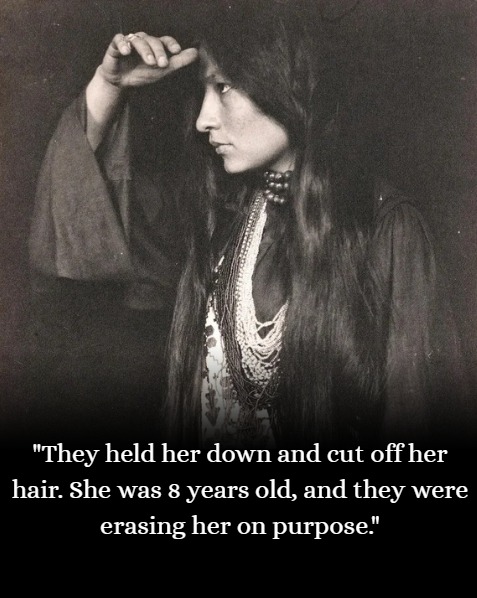
On her first day, they lined up all the Native children. Zitkala-Ša watched in horror as, one by one, they cut off the children’s long hair.
In Dakota culture, only mourners and cowards wore short hair. It was a mark of shame.
When they came for her, she ran. She hid under a bed, trembling.
They dragged her out. Held her down. And cut it all off anyway.
She would later write: “I felt the cold blades of the scissors against my neck, and heard them gnaw off one of my thick braids. Then I lost my spirit.”
She was eight years old.
But losing her spirit and losing her voice turned out to be two different things.
For years, Zitkala-Ša endured the boarding school’s brutal assimilation. They forbade her language. Punished her culture. Taught her that everything about being Dakota was wrong, savage, something to be ashamed of.
She learned English. She learned to play violin. She learned to speak like them, write like them, dress like them.
But she never forgot who she was underneath.
At 19, she left the school system and began to write. Not in Dakota—they’d taken that language from her. But in English, weaponized against those who’d tried to erase her.
In 1900, her essays appeared in “The Atlantic Monthly.”
They were unlike anything white America had read before. She wrote about the violence of forced assimilation. The trauma of children stolen from their families. The lie that “civilization” was rescue when it was actually destruction.
She described the boarding school experience with devastating clarity: the loneliness, the punishment, the systematic attempt to kill Indigenous identity.
“Few there are who have paused to question whether real life or long-lasting death lies beneath this semblance of civilization,” she wrote.
White readers were shocked. They’d been told Indian boarding schools were benevolent. That they were helping. That Native children were grateful.
Zitkala-Ša showed them the truth: These weren’t schools. They were erasure machines.
But she didn’t just write about loss. She fought to preserve what remained.
In 1901, she published “Old Indian Legends”—Dakota stories passed down through generations, now recorded in English so they couldn’t be lost. It was both an act of preservation and an act of defiance.
She wrote “American Indian Stories” in 1921, blending memoir with cultural commentary. She became one of the most prominent Native American voices of her generation.
But writing wasn’t enough. She wanted action.
Zitkala-Ša spent decades lobbying Congress, investigating corruption in the Bureau of Indian Affairs, and organizing Indigenous communities.
She exposed how the government was stealing Native land through legal manipulation. She fought for citizenship rights for Indigenous peoples—rights that wouldn’t be fully granted until the Indian Citizenship Act of 1924.
In 1926, she co-founded the National Council of American Indians and became its president. For 12 years until her death, she used that platform to fight for Indigenous self-determination, land rights, and cultural preservation.
She also composed music. In 1913, she wrote “The Sun Dance,” an opera combining Native themes with Western classical music—another way of proving Indigenous culture could exist in modern forms without being erased.
She refused to choose between being Dakota and being educated. Between tradition and progress. Between her past and her future.
She insisted—through her writing, her activism, her very existence—that Indigenous people could be both. That assimilation wasn’t salvation. That their cultures deserved to survive.
Zitkala-Ša died on January 26, 1938, at age 61.
She never got her childhood back. She never fully recovered what the boarding schools had taken from her.
But she made sure future generations wouldn’t lose as much as she did.
Her essays are still taught in schools—the same kinds of schools that once tried to erase her.
Her stories are still read, preserving legends that missionaries tried to bury.
And her activism laid groundwork for Indigenous rights movements that continue today.
They cut off her hair when she was eight, thinking they could erase her.
Instead, they created someone who would spend her entire life making sure Native voices could never be silenced again.
She lost her spirit that day under the scissors.
But she spent the rest of her life taking it back—and giving it to every Indigenous child who came after her.
Zitkala-Ša (Gertrude Simmons Bonnin)
February 22, 1876 – January 26, 1938
Writer. Activist. Violinist. Survivor.
The girl they tried to erase became a voice they couldn’t silence.