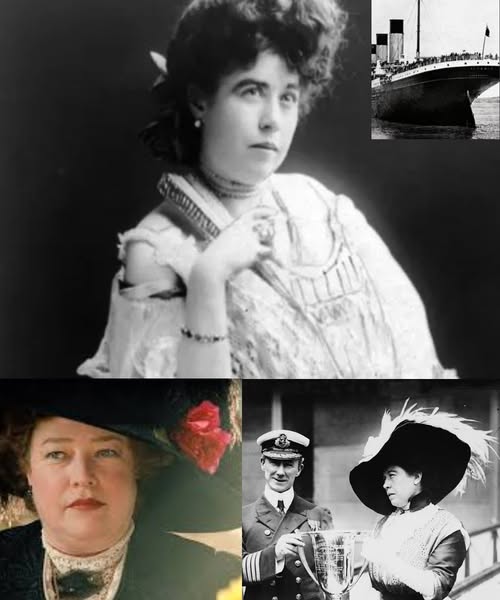
When the Titanic sank, amid the freezing ocean and the broken screams of fear, a woman stood up. She didn’t scream. She didn’t cry. She didn’t wait. She grabbed an oar. She stepped forward. And everything changed.
That woman was Margaret “Molly” Brown. While James Cameron’s cinematic masterpiece, Titanic, made her famous (portrayed by Kathy Bates), her true story is far more compelling than a single night of maritime disaster. She was an extraordinary activist, philanthropist, and an emancipated woman whose life proves she was truly ahead of her time.
Margaret Brown loved travel and the social life: she was in Egypt when a letter informed her of her nephew’s illness. So Molly returned to France and boarded the first available ship to the United States: the Titanic.
The rest is history: during the turbulent hours of the tragedy, she did not lose heart, and before boarding the lifeboat, she decided to search for those left behind.
In the chaotic aftermath of the collision, Molly did not descend into panic. Put onto Lifeboat No. 6, she confronted the frightened sailor in command.
She took the oar herself, rowing aggressively to move the boat away from the sinking liner and the massive whirlpool it created, ensuring the safety of those aboard.
Upon rescue by the RMS Carpathia, her leadership continued. Speaking three languages, she immediately organized aid and established a relief fund for the penniless survivors, leveraging her own wealth to help others.
Molly Brown’s commitment to others began long before the disaster. Born poor, she and her husband acquired a fortune in the Colorado mining boom. Crucially, their wealth did not isolate her.
Molly tirelessly championed miners’ rights, fought for women’s suffrage, and dedicated herself to education and charity. She was a woman of culture and society, yes, but her focus was always on those less privileged. She paid for the education of young women and constantly spoke out on issues of social reform.
Following the sinking, Margaret wanted to use her platform and experience to testify about the disaster, to ensure better safety measures were implemented. However, despite her critical help, she was often dismissed or prevented from giving her account simply because she was a woman.
But she never fell silent. Her bravery and philanthropic work were eventually recognized globally; the French government awarded her the Legion of Honor in 1932 for her humanitarian efforts.
Molly Brown’s legacy is not just that she survived the Titanic, but that she demonstrated that one can sink a ship, but not a woman driven by courage and purpose.
She showed the world how to grab an oar, take command, and rebuild.
That night, the freezing water took a ship, but it gave the world a legend: a woman who never asked for permission to save others, and whose spirit, even today, refuses to sink.
>We Are Human Angels<
Authors
Awakening the Human Spirit
We are the authors of ‘We Are Human Angels,’ the book that has spread a new vision of the human experience and has been spontaneously translated into 14 languages by readers.
We hope our writing sparks something in you!