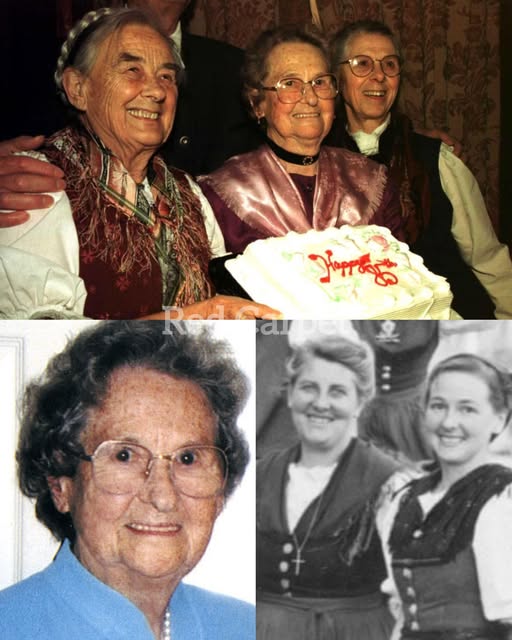
Agathe von Trapp lived long enough to see herself turned into fiction. And in her quiet, steady way, she spent her final years untangling the myths that Hollywood stitched around her family like embroidery.
People who watched The Sound of Music believed they knew her. They thought she was the shy eldest daughter, the one who sang on mountaintops and skipped through meadows. But Agathe was nothing like the girl on the screen. Her life began not in a world of technicolor romance, but in 1913, in the fading days of the Austro-Hungarian Empire, a time of discipline, naval uniforms, and a father whose bravery had earned him medals and scars.
She grew up surrounded by siblings, music, and the rigid structure of a military household. Her mother’s death when Agathe was only nine did not come with swelling violins. It came with silence—deep, aching, and heavy. Seven children left without the person who had held their world together.
Then Maria arrived—not the carefree whirlwind Hollywood preferred, but a young woman with fierce opinions, a sharp mind, and a backbone that could stop an argument in its tracks. She taught them music, yes, but also order, discipline, and a sense of purpose that kept their fractured household from collapsing.
Agathe thrived in that environment. She was not a child skipping through alpine fields; she was a trained soprano with an ear for harmony and a seriousness that made her the quiet anchor of the group. Long before Rodgers and Hammerstein turned them into storybook characters, the von Trapps were touring Europe as a refined, technically skilled ensemble.
That life ended overnight in 1938.
The Anschluss brought swastikas onto Austrian buildings and impossible choices to the von Trapp doorstep. Captain Georg von Trapp—once a hero of the Austrian Navy—was offered a prestigious position within Hitler’s forces. It was safety, security, and wealth wrapped in a uniform he refused to wear.
The movie turned their departure into a dramatic race across the mountains.
The truth was subtler and far more frightening.
They walked to a train station in broad daylight, each carrying a small bag, each pretending they were still the respected Trapp family on tour. One wrong word, one moment of hesitation, and the life they were leaving behind would have closed around them like a trap. But they boarded that train to Italy with calm faces and pounding hearts.
They never returned.
America wasn’t waiting with applause. It offered them steel-gray uncertainty. Refugee life. Hard benches in train stations. Endless introductions. And always—money that ran out too quickly.
So they sang. Night after night. In churches so cold they could see their breath. In community halls where folding chairs creaked like old bones. The glamorous image of the Trapp Family Singers came years later. In the beginning, survival was their only audience.
Agathe sang through it all—the exhausting travel, the constant rehearsals, the unfamiliar landscapes. But in the early 1950s, after more than a decade of performing, she felt a quiet truth rising in her chest: the stage no longer felt like home.
And so she walked away.
Not dramatically, not angrily—just with the same steady resolve that had carried her across continents. She moved to Maryland and became a kindergarten teacher, trading crowded concert halls for the soft chaos of small children learning their letters. It was a life untouched by spotlight, and she chose it deliberately.
Meanwhile, The Sound of Music erupted into a worldwide sensation. People adored the songs, the romance, the triumph. But the more the film grew, the more Agathe recognized pieces of her life twisted into fairy tale simplicity. Her family turned into charming caricatures. Her stepmother softened into a saint. Their flight from Austria repainted in strokes so bold they concealed the truth.
For decades, she said little.
Then, at 90, she finally spoke.
Her memoir wasn’t a complaint. It was a gentle recollection, a careful unbraiding of fact from legend. She honored the movie’s beauty, but she insisted on accuracy—because her family’s sacrifices deserved more than a catchy melody.
Agathe von Trapp died at 97, without fanfare, in a small hospice room in Maryland. No orchestral finale. No sweeping hills. Just the quiet passing of a woman whose life had been extraordinary long before Hollywood noticed it.
And in the end, she left behind something more enduring than the myth that overshadowed her.
She left the truth.