His name was Sgt. Stubby, and he was just a scrappy little stray from the streets of Connecticut when he wandered into military history like it was the most natural thing in the world.
He wasn’t a German Shepherd or a Doberman.
Not a trained K-9 or a pedigreed mascot.
He was… well, kind of a chonky terrier–pit bull mix with big eyes, a bigger heart, and legs just long enough to keep up when it mattered.
In 1917, a young soldier named Private J. Robert Conroy found the quirky stray wandering around the Yale University campus, where troops were training before shipping out to Europe for World War I. Stubby took one look at Conroy — and decided that was his human.
The soldiers took to him instantly.
He learned the drills.
He marched with the men.
He even saluted — raising his paw to his brow like he’d been doing it his whole life.
When it came time to deploy, dogs weren’t allowed on ships.
So Conroy smuggled Stubby aboard, hiding him in the coal bin until it was too late to turn the ship around. When Stubby popped out on deck and saluted the commanding officer, the man burst out laughing — and gave him permission to stay.
And thank goodness he did.
Because Stubby wasn’t just a mascot.
He became a soldier.
In France, he quickly proved he had instincts no training could teach. He could hear incoming artillery before the men did, barking warnings that sent soldiers diving into trenches seconds before the shells hit.
He learned to identify the smell of mustard gas and would run from soldier to soldier in the night, frantically waking them to put on their masks.
Stubby carried messages across the front lines.
He found wounded men in no-man’s-land.
He stood guard at night, growling whenever he sensed danger crawling closer in the dark.
He served in 17 battles and 4 major offensives, surviving fire, gas, and chaos right alongside the humans who had become his pack.
And then came the moment that made him a legend.
One day, Stubby spotted a German spy sneaking toward the American trenches. Without hesitation, the little dog sprang forward, sinking his teeth into the man’s leg and holding on with everything he had. The spy stumbled, fell, and was captured.
For this, Stubby was “promoted” to Sergeant — outranking half the men in the unit.
(And yes, they saluted him.)
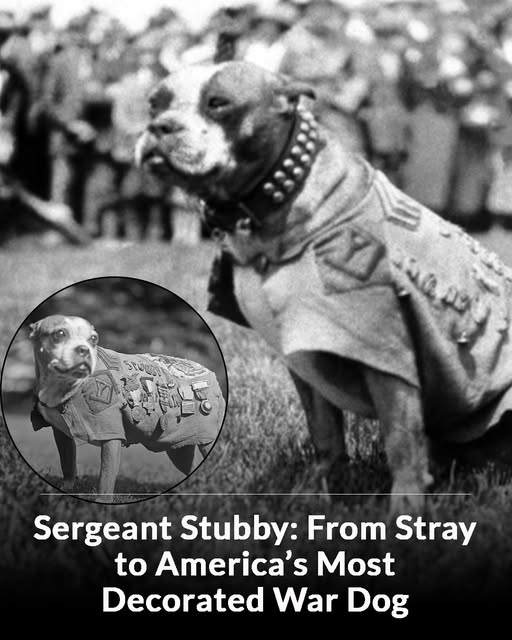
Stubby wore a custom-made military coat covered in medals, patches, and honors given by grateful soldiers, generals, and even foreign governments. He became a symbol of loyalty and courage — a reminder that bravery doesn’t require size, and heroism doesn’t require species.
When the war ended, Stubby returned to the United States as a celebrity. He marched in parades, met presidents, and became the official mascot of Georgetown University, where Conroy studied law.
Years later, when Stubby passed away peacefully in his sleep, his obituary ran in newspapers across the country. The nation mourned a dog who had lived — and loved — like a warrior.
Today, his preserved remains rest at the Smithsonian, wearing the same little coat stitched with stories of a hundred lifetimes. Visitors still stop, smile, and shake their heads — because how could a dog so small leave a legacy so big?
Stubby didn’t have pedigree, permission, or a plan.
He just had heart.
And sometimes, heart is all a hero needs.