In the winter of 1925, the remote town of Nome, Alaska was trapped under ice and fear. A deadly diphtheria outbreak was spreading fast, children were dying, and the town’s tiny supply of antitoxin was gone. The nearest medicine was 674 miles away, across frozen tundra and hurricane-strength blizzards.
Planes couldn’t fly.
Ships couldn’t move.
The temperature was –60°F.
So Alaska turned to the one force that never failed them:
sled dogs.
What followed became known as the Great Race of Mercy — a relay of mushers and dogs pushing through darkness, ice, and storms powerful enough to kill a grown man within minutes.
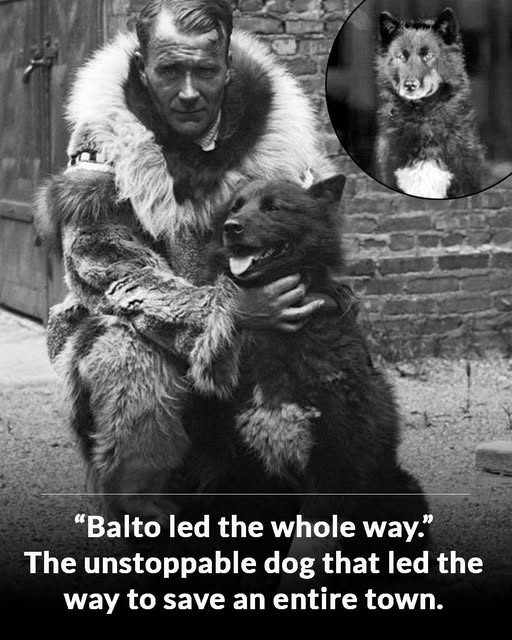
Balto wasn’t the biggest dog.
Wasn’t the fastest.
And definitely wasn’t the one anyone expected to lead the final, most dangerous leg of the journey.
In fact, Balto was considered “average” — a dependable but unremarkable Siberian husky who usually ran in middle positions, not at the front. The Superstar of the kennel was another dog named Togo, who led his team on an unbelievable 260-mile stretch that historians still call the greatest feat in sled dog history.
But when the last leg came, musher Gunnar Kaasen made a bold choice.
He put Balto at the front.
Because Balto, more than any dog he’d ever seen, had a sense of direction like a compass wired to the earth.
And the final run?
It needed a dog who could find the way when visibility dropped to zero.
Late on the night of February 1, 1925, Kaasen and Balto’s team set off into a storm so violent it erased the horizon. Wind slashed like knives. Snow blinded them. The trail markers vanished. Men had died in better conditions.
And yet Balto ran.
At one point, Kaasen couldn’t see the lead dogs at all — the storm was that thick. He yelled into the darkness, praying they were still alive, still running.
Balto never hesitated.
He forged ahead, trusting something deeper than sight.
Then disaster struck.
A hurricane-force gust flipped the sled, launching the antitoxin into the snow. Kaasen clawed through the darkness, panicked, numb, desperately searching for that one small box — the box the entire town depended on.
He found it.
Barely.
If he hadn’t, the run would’ve been for nothing.
He repacked the sled with shaking hands, reattached the dogs, and whispered to Balto,
“Go.”
And Balto went.
Through the night.
Through the winds.
Through the kind of cold that shatters bone and freezes air in your lungs.
When they reached Nome at 5:30 a.m., both Kaasen and Balto were coated in ice. The dogs’ sides heaved with exhaustion. The medicine — frozen to the sled — was delivered.
They had saved the town.
A crowd gathered, stunned. Someone asked how they made it.
Kaasen pointed at the little black dog in front.
“Balto led the whole way.”
Balto became a global hero overnight. Newspapers celebrated him. Children sent letters. The mayor of New York held a parade in his honor. A statue was raised in Central Park, where it still stands today.
But Balto didn’t care about fame.
He cared about doing the job he was born to do — running into storms and never giving up.
He spent his later years touring, then living peacefully at the Cleveland Zoo, where he was loved and visited by schoolchildren who grew up on the legend of the brave sled dog who saved a town.
When he passed away in 1933, his body was preserved and placed in the Cleveland Museum of Natural History — not as a trophy, but as a tribute.
Balto wasn’t the fastest.
He wasn’t the strongest.
But when the world needed a hero, he ran into the storm.
And he didn’t stop until the children of Nome had hope again.