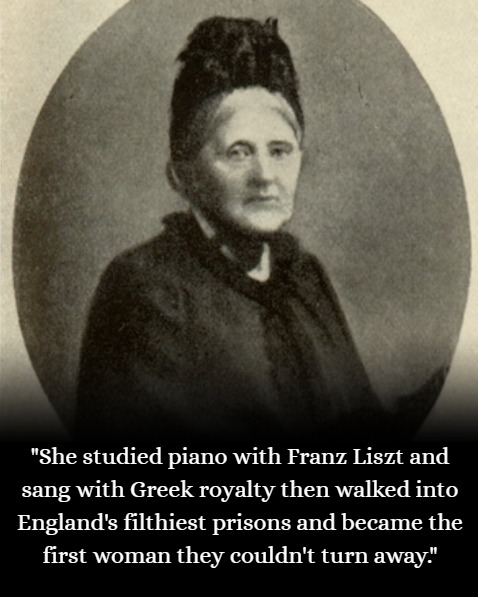
She studied piano with Franz Liszt and sang with Greek royalty—then walked into England’s filthiest prisons and became the first woman they couldn’t turn away.
Her name was Felicia Skene, and her life reads like a novel that moves from European salons to the stark reality of 19th-century prison cells—except it’s all true.
Born in 1821 in Aix-en-Provence to a Scottish family of artists and diplomats, Felicia grew up surrounded by everything Victorian society valued: intellect, art, culture, refinement.
As a young woman, she studied piano with Franz Liszt in France—one of the greatest composers alive. She sang with the Greek royal family in Athens, moving through courts and salons where power and privilege were simply the air everyone breathed.
Her early years were steeped in music, languages, art, and all the beauty money and status could provide.
Then she chose to walk away from all of it.
Not dramatically. Not as rebellion. But as something more radical: a quiet, deliberate decision to use her privilege for people society wanted to pretend didn’t exist.
When Felicia settled in Oxford at 34 St Michael’s Street, she could have continued the comfortable life of a cultured Victorian gentlewoman—hosting salons, attending concerts, perhaps writing poetry about flowers.
Instead, in 1854, when cholera swept through Oxford, Felicia walked directly into the outbreak.
While others fled or locked their doors, she worked alongside Sir Henry Acland—one of Oxford’s most respected physicians—tending to the sick and dying. The stench of disease. The horror of watching people die in agony. The constant risk of infection.
Felicia didn’t flinch.
But when the epidemic passed, something had changed in her.
She’d seen suffering. She’d seen who got help and who got abandoned. She’d seen that society drew very clear lines about whose lives mattered.
And she decided those lines were unacceptable.
Felicia turned her attention to the people Victorian England most wanted to forget: prisoners.
In the 1850s, prisons were nightmares. Men, women, and children mixed together in filthy cells. No rehabilitation. No hope. Just punishment, disease, and despair.
And women had it worst of all—no separation from male inmates, no advocates, no one who cared what happened to them once those iron doors closed.
Felicia became the first woman officially permitted to visit prisoners in England.
Not as a tourist observing the “fallen.” Not as a moral scold lecturing the wicked. But as an ally who believed these people—criminals, prostitutes, the desperate and broken—deserved dignity.
She showed up. Week after week, year after year.
Known affectionately as “Fifi,” she played the harmonium in the prison chapel, bringing music back into lives that had known only harshness.
She met newly released prisoners at dawn—at dawn!—outside the prison gates with a warm meal. Imagine that: a woman of refinement and education standing in the cold morning light, waiting to feed someone the world had just finished punishing.
She offered advice, connections, sometimes money. She gave people a chance when everyone else had decided they deserved none.
Her advocacy helped push for revolutionary prison reform.
The separation of male and female inmates—a concept that seems obvious now but was radical then. The idea that prisons should rehabilitate, not just punish. The belief that women prisoners deserved female guards and advocates.
These weren’t abstract policy positions for Felicia. They came from sitting with prisoners, hearing their stories, seeing the system destroy people who could have been saved.
Her Oxford home—fondly nicknamed “The Skene Arms”—became legendary.
It wasn’t a metaphor. It was literally a refuge for anyone who needed one.
Students struggling with poverty or depression. Clergy wrestling with doubts. Prostitutes trying to escape that life. The poor. The desperate. The broken.
All found an open door and an open heart at 34 St Michael’s Street.
Victorian society had very strict rules about who belonged in respectable homes. Felicia ignored every single one.
She was also a gifted writer who published more than twenty books.
Often under pseudonyms—because respectable Victorian women weren’t supposed to write publicly about the things Felicia wrote about.
Her novel Hidden Depths (1866) emerged directly from her work with Oxford’s “fallen women”—prostitutes, criminals, the women Victorian society preferred to pretend didn’t exist.
The book revealed the moral hypocrisy and social injustices that created these women’s circumstances. The double standards. The economic desperation that pushed women into prostitution while society blamed them for moral weakness. The men who used these women and then condemned them.
Victorian England didn’t want to hear it. But Felicia made them listen.
And she gave every penny of her writing earnings to her causes.
Every. Single. Penny.
She could have lived comfortably on her book income. Instead, she used it to fund prison visits, help released prisoners, support the refuge work at “The Skene Arms.”
She’d been born into privilege—education, culture, connections, comfort. She spent her entire adult life using that privilege to serve people who had none.
Not as charity from above. Not as pity. But as genuine belief that these people deserved dignity, second chances, and someone who wouldn’t abandon them.
Felicia Skene died in 1899.
She left behind no children. No fortune. No aristocratic title or position.
But she left an enduring legacy of compassion transformed into action.
She left prison reforms that improved countless lives. She left books that exposed uncomfortable truths. She left a model of what it means to use privilege responsibly.
And she left dozens—maybe hundreds—of people who’d been given second chances when everyone else had written them off.
Today, a blue plaque adorns her former home at 34 St Michael’s Street in Oxford.
Most people walk past it without noticing. Most have never heard of Felicia Skene.
But she deserves to be remembered.
Because Felicia Skene proved something vital: that privilege isn’t about what you have, it’s about what you do with it.
She could have spent her life in comfort, surrounded by beauty and refinement, enjoying the culture and status her family’s position provided.
Instead, she spent it in prison cells and at dawn meetings outside prison gates. She spent it opening her home to people respectable society avoided. She spent it writing uncomfortable truths and giving away every penny to people who needed it more.
She studied with Liszt and sang with royalty—then chose to play harmonium in a prison chapel because that’s where music was needed most.
That’s not just compassion. That’s courage.
Courage to refuse the comfortable life she could have had. Courage to walk into places others avoided. Courage to advocate for people society wanted to forget. Courage to use her voice, her home, her resources, her entire life for people who couldn’t repay her.
Victorian England had very clear ideas about what refined, educated women should do with their lives.
Felicia Skene ignored every single expectation—and changed the world for people who needed someone to believe they were worth saving.
From European salons to prison cells. From privilege to purpose. From comfort to courage.
That’s the life of Felicia Skene—the woman who refused to turn away from suffering, and instead transformed empathy into action that echoed long after her death.
The blue plaque on 34 St Michael’s Street is quiet, easy to miss.
But the legacy it marks is anything but quiet.
It marks a woman who heard music in the finest courts of Europe—and chose to bring it to the darkest prisons in England.
That’s not just a life well-lived.
That’s a life that mattered.